
The short answer
Choose Lygu’s monthly-review approach when you want a clear view of cash, investments, debts, assets, income, and net-worth direction without logging every purchase or connecting bank accounts.
Choose daily transaction budgeting when you need exact category spending, real-time limits, shared budget coordination, or detailed records of where money goes.
| Question | Lygu | Daily budgeting |
|---|---|---|
| Primary view | Whole financial picture | Individual transactions and categories |
| Typical rhythm | About 15 minutes once a month | Daily or several times a week |
| Data entry | Periodic balances and context | Transactions, categories, and adjustments |
| Bank connection | None | Often available or required, depending on the app |
| Best at showing | Meaningful monthly changes and direction | Exact spending patterns and category limits |
| Main tradeoff | Less transaction-level detail | More ongoing maintenance |
What Lygu helps you understand
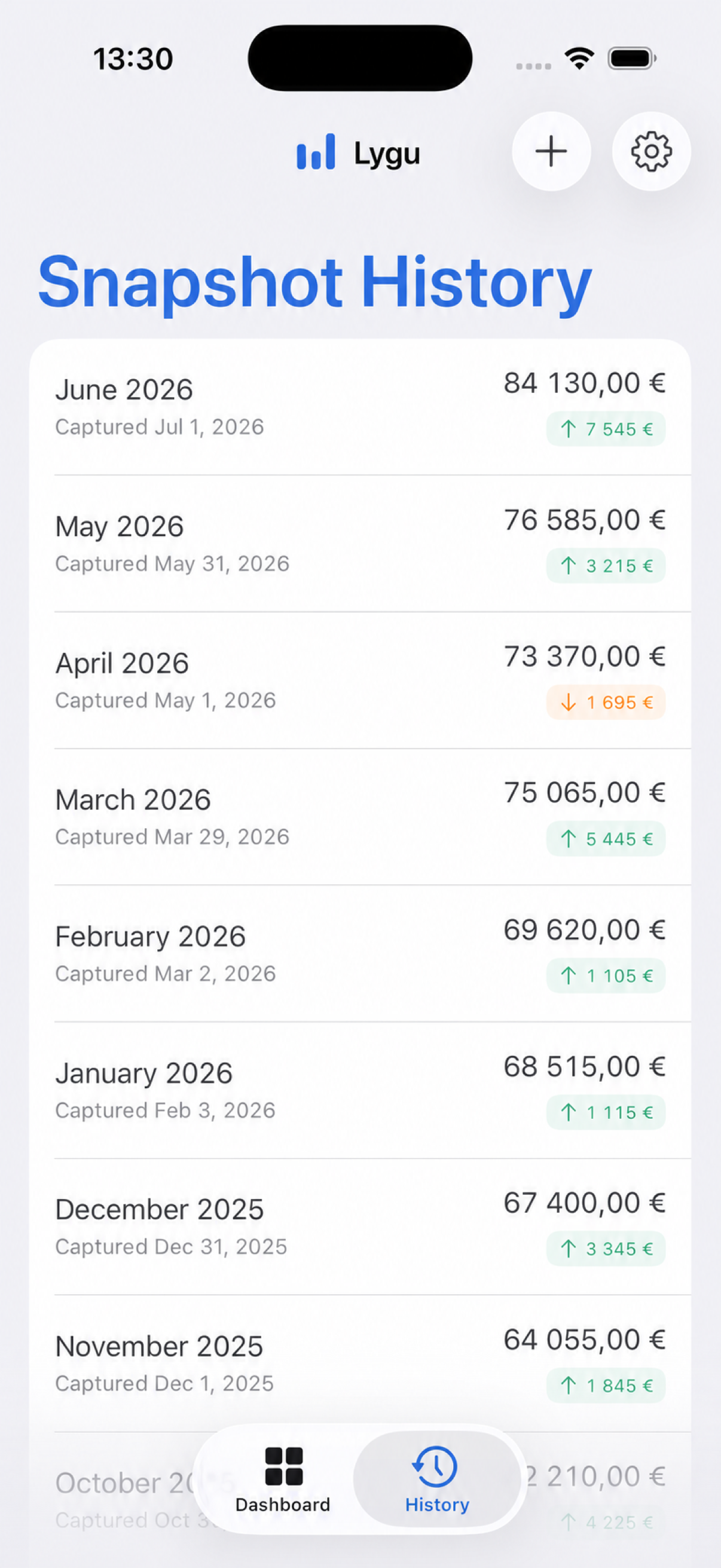
Each Lygu snapshot brings together current values for cash, investments, debts, other assets, and income. Comparing snapshots can show how net worth and key categories moved, while reflection notes preserve the context that numbers alone cannot explain.
When income is available, Lygu can estimate spending from the change in cash. This is a broad estimate, not a breakdown by merchant or category.
What detailed budgeting does better
A transaction-based budget is better suited to questions such as:
- How much did I spend on a particular category this week?
- How much is left in a specific spending envelope?
- Which subscriptions or merchants account for recurring costs?
- How should two people coordinate shared household spending?
Lygu is not designed to answer those questions. It does not import or categorise transactions and should not be treated as accounting software.
Effort changes what you will keep using
The most sophisticated system has little value if its routine is too demanding to maintain. Some people enjoy daily budgeting and benefit from its precision. Others stop after a few weeks because every correction and category becomes another small obligation.
Lygu deliberately reduces the frequency and detail of the task. The intention is not to make finance effortless, but to create a useful habit with a manageable amount of attention.
You can combine approaches. Use a detailed budget temporarily for a specific problem while keeping a monthly snapshot as your long-term financial record.
Choose Lygu if these statements sound familiar
- I want to understand my overall situation more than every purchase.
- I have abandoned expense trackers because they required too much upkeep.
- I prefer entering balances manually instead of connecting my banks.
- I want investments, debts, assets, cash, and income in the same review.
- A monthly routine feels more realistic than a daily one.
Start with one monthly snapshot.
Follow a short routine and see whether the lower-maintenance approach fits you.
Try the 15-minute routine