
Before you begin
Pick a repeatable time, such as the first weekend of each month. Have access to the accounts and balances you want to include. If this is your first review, you are creating a baseline; the comparison becomes more useful next month.
- Set aside a focused moment.
Give yourself about 15 minutes without trying to solve every financial question. The goal is to complete a useful check-in, not conduct an audit. - Record your current snapshot.
Note your cash, investment, debt, and other-asset balances. Use the same broad categories each month so the comparison stays consistent. - Add the month’s context.
Include income and investment contributions or withdrawals if they help explain the change. Remember unusual events such as a large annual bill, a bonus, travel, or a planned purchase. - Compare with last month.
Look across the whole picture before focusing on one number. Which category changed most? Did debt decrease? Did cash move for a clear reason? Is your net-worth direction different from what you expected? - Leave one reflection.
Write one sentence about what you noticed and, if useful, one small next action. Then finish. A repeatable review is more valuable than an exhaustive one you avoid next month.
Questions worth asking
- What changed most since the previous snapshot?
- Was the change expected, temporary, or unexplained?
- Are my cash reserves still comfortable for my situation?
- Did debt and investments move as intended?
- Is there anything I want to remember when I review next month?
Avoid turning every question into a task. Observation is already useful. Take action only where the review reveals something that genuinely needs attention.
Your first snapshot is enough. You do not need to recreate past months. Start with today’s balances and let the history grow naturally.
Keep the categories stable
The value of a monthly review comes from comparison. Renaming and reorganising everything each month creates noise. Begin with a small, understandable structure and change it only when your financial life actually changes.
You can still add context in a reflection. A short note often explains more than creating a new category for every exceptional event.
Reviewing with Lygu
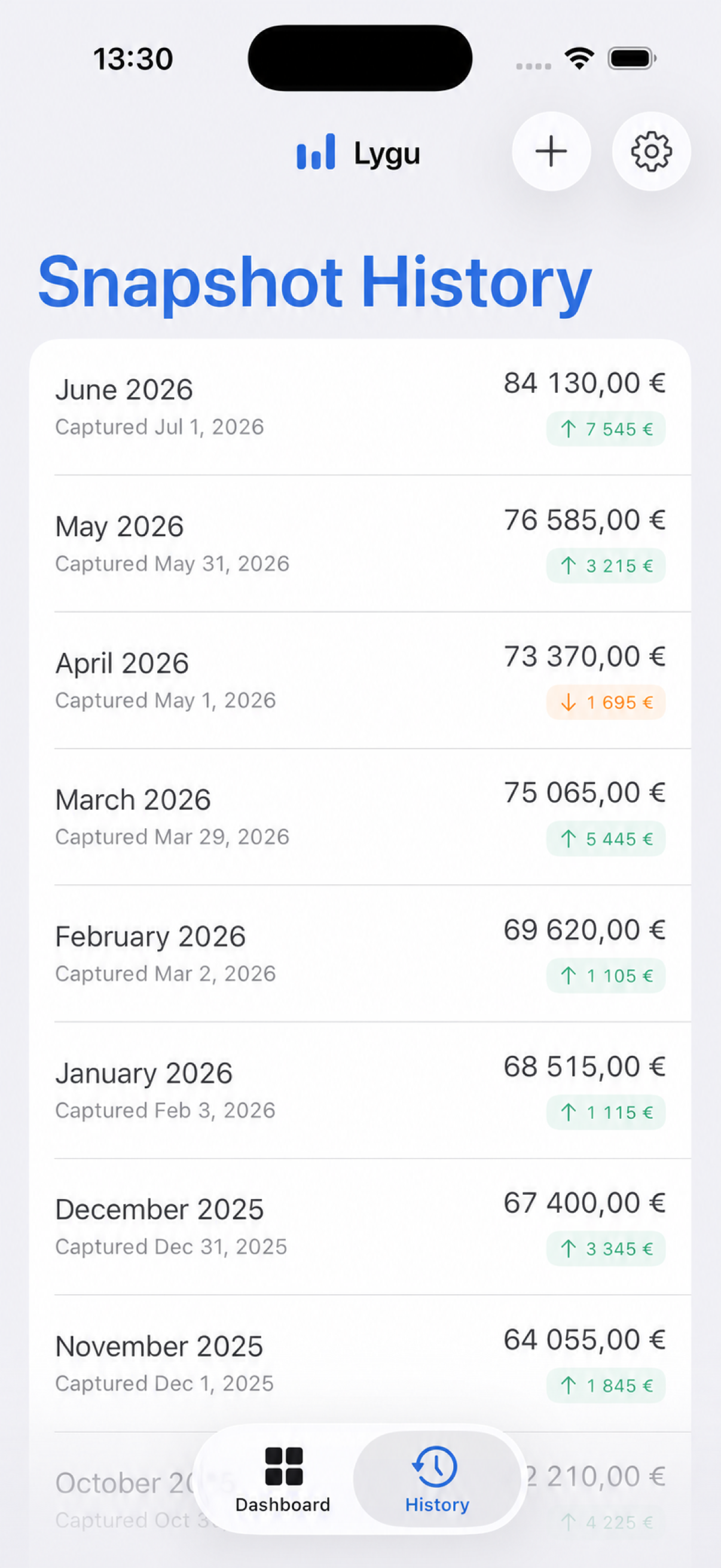
Lygu turns this routine into a guided iPhone workflow. You create periodic snapshots, review calculated changes, browse your history, and add reflection notes. When income is available, Lygu can estimate spending from the change in cash without requiring individual transactions.
Lygu requires no bank connection or account. Financial records stay in the app’s local database on your phone, while limited privacy-preserving usage analytics help improve the product.
Your 15-minute checklist
Use this checklist without an account or download. Allow longer for your first setup.
Ticks are temporary and reset when you reload this page. See a fully worked two-month example.
Build perspective one month at a time.
Learn why the monthly snapshot works and what it can show you over time.
Understand the monthly review