
A snapshot, not a stream of transactions
Most financial activity happens continuously: money arrives, bills are paid, investments move, and balances change. A monthly review pauses that stream long enough to answer a simpler question: where do things stand now, compared with last month?
The result is a financial snapshot. It does not try to reconstruct every purchase. It gives you a repeatable view of the parts of your money that matter most to you.
What to include
A useful review usually brings together five areas:
- Cash: current balances in the accounts you use or save in.
- Investments: current values, plus any money contributed or withdrawn during the month.
- Debts: credit cards, loans, mortgages, or other balances you want to reduce.
- Other assets: valuable items or property that belong in your personal picture.
- Income: money received during the period, when you want a broader cash-flow view.
You do not need to include everything you own. Consistently reviewing the same meaningful categories is more useful than building an exhaustive list that becomes difficult to maintain.
The aim is perspective. A monthly review should help you understand direction, not make you account for every coffee or defend every purchase.
What the comparison can reveal
One snapshot tells you where you are. Two or more snapshots show movement. You can see whether cash increased or decreased, whether debt moved in the direction you expected, how investments changed, and how your overall net worth developed.
When income is included, the change in cash can also support an estimate of spending. That estimate is intentionally broader than transaction-level categorisation: it helps you see the month without maintaining a daily ledger.
Who this approach suits
A monthly review can work well if you want to understand your finances but dislike continuous maintenance. It may be especially useful when you:
- have tried expense trackers and stopped using them;
- prefer not to connect your bank accounts to an app;
- want to see cash, investments, debts, and assets together;
- care more about meaningful direction than individual purchases;
- can commit to one short routine more easily than a daily habit.
It is not the only valid approach. Detailed tracking can be useful when you need exact category limits, shared household budgeting, reimbursement records, or close control over irregular spending.
How Lygu supports the habit
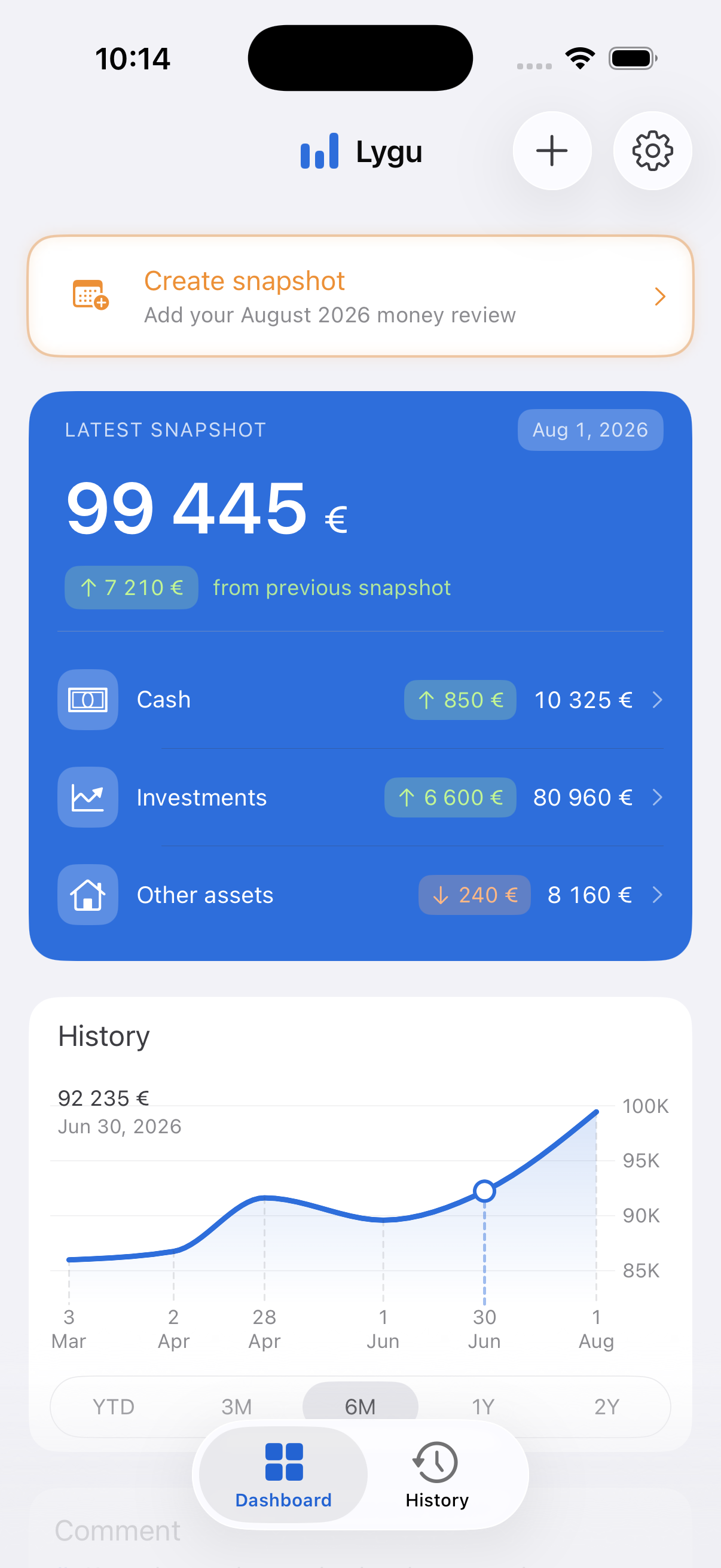
Lygu is a private iPhone app built specifically around this monthly rhythm. In about 15 minutes, you create a snapshot, compare it with the previous one, and optionally leave a reflection for your future self.
There is no bank connection and no Lygu account. Financial records are stored locally on your phone. Limited privacy-preserving usage analytics are used to improve the app, as explained in the privacy policy.
A two-month example
Fictional example: these amounts illustrate the method, not a real person’s finances or a promised result. The screenshots elsewhere on this page use separate demonstration data.
| Category | July | August | Change |
|---|---|---|---|
| Cash | €4,000 | €4,300 | +€300 |
| Investments | €6,000 | €6,400 | +€400 |
| Other assets | €2,000 | €2,000 | €0 |
| Debt | €1,500 | €1,300 | −€200 |
| Net worth | €10,500 | €11,400 | +€900 |
You enter the balances; Lygu calculates the totals. With all four categories included, net worth is cash + investments + other assets − debt. Here it rises by €900: €300 more cash, €400 more investments, and €200 less debt.
For August, suppose you also enter €2,500 income, €300 investment contributions, and no investment withdrawals. The monthly spending estimate is €4,000 + €2,500 − €300 − €4,300 = €1,900. This is a cash-flow estimate, not a purchase-by-purchase total; debt payments or other cash movements may be included. Review unusual transfers before interpreting it.
The €400 rise in investments is not all investment growth: after the €300 contribution, the estimated growth is €100. These comparisons need an earlier snapshot and consistent inputs. Spending also needs complete income for the covered period; across skipped months, Lygu calculates a monthly average.
A possible reflection: “Cash rose by €300 and debt fell by €200. My €300 investment contribution explains most of the investment increase. Next month I’ll check whether the higher cash balance has held.”
Common questions
Can I start without previous records?
Yes. Start with your current balances. The first snapshot is a baseline; comparisons need a later snapshot.
Does a review have to take exactly 15 minutes?
No. About 15 minutes is the intended routine, not a time limit. First-time setup or many accounts can take longer.
Does Lygu tell me exactly where I spent money?
No. It estimates spending from cash balances, income, and investment activity. It does not categorise individual purchases.
Can I browse every previous snapshot for free?
The latest snapshot in History is available without Pro. Full snapshot history, additional dashboard analysis, and export require Lygu Pro. See features and pricing.
Try one focused check-in.
Use the practical routine to complete your next monthly review in about 15 minutes.
Follow the monthly routine