
Why detailed tracking is difficult to maintain
Transaction tracking can answer precise questions: exactly how much went to groceries, subscriptions, transport, or eating out? For some people, that detail is useful and worth the work.
For others, the routine becomes the problem. Transactions need to be imported or entered, categories need correction, transfers need special treatment, and small purchases receive constant attention. The system may be abandoned before enough history exists to become useful.
This does not mean expense tracking is ineffective. It means the right level of detail depends on the question you actually need to answer.
A different question
A monthly money review does not begin with “Where did every euro or dollar go?” It begins with broader questions:
- What changed across my cash, investments, debts, and assets?
- Did my overall financial position move in the direction I expected?
- Was this an unusual month, or part of a longer pattern?
- Is there one thing I want to remember or do next?
Those questions can often be answered from periodic balances, income, and a short reflection. You give up transaction-level precision in exchange for a routine that may be easier to repeat.
A monthly snapshot is intentionally approximate. It is designed to reveal meaningful movement, not replace accounting, tax records, or a category-by-category budget.
Three alternatives to logging every purchase
1. Monthly financial snapshots
Record current balances for the categories that matter, then compare them with the previous month. This works well for a whole-picture view and net-worth direction.
2. Account-level limits
Keep a separate amount available for flexible spending and monitor only that balance. This gives you a boundary without maintaining detailed categories.
3. Short, temporary tracking
Track transactions for a defined period when you have a specific question, then stop. A two-week or one-month sample can be more realistic than promising yourself permanent daily maintenance.
When detailed expense tracking is still the better fit
Choose more detailed tracking when you need exact spending categories, strict weekly limits, shared household coordination, business records, reimbursements, or evidence for a specific financial decision. A broad monthly review is not a substitute for those needs.
Choose the lighter approach when your main goal is to understand direction, notice meaningful changes, and maintain a habit you are more likely to continue.
How Lygu approaches the problem
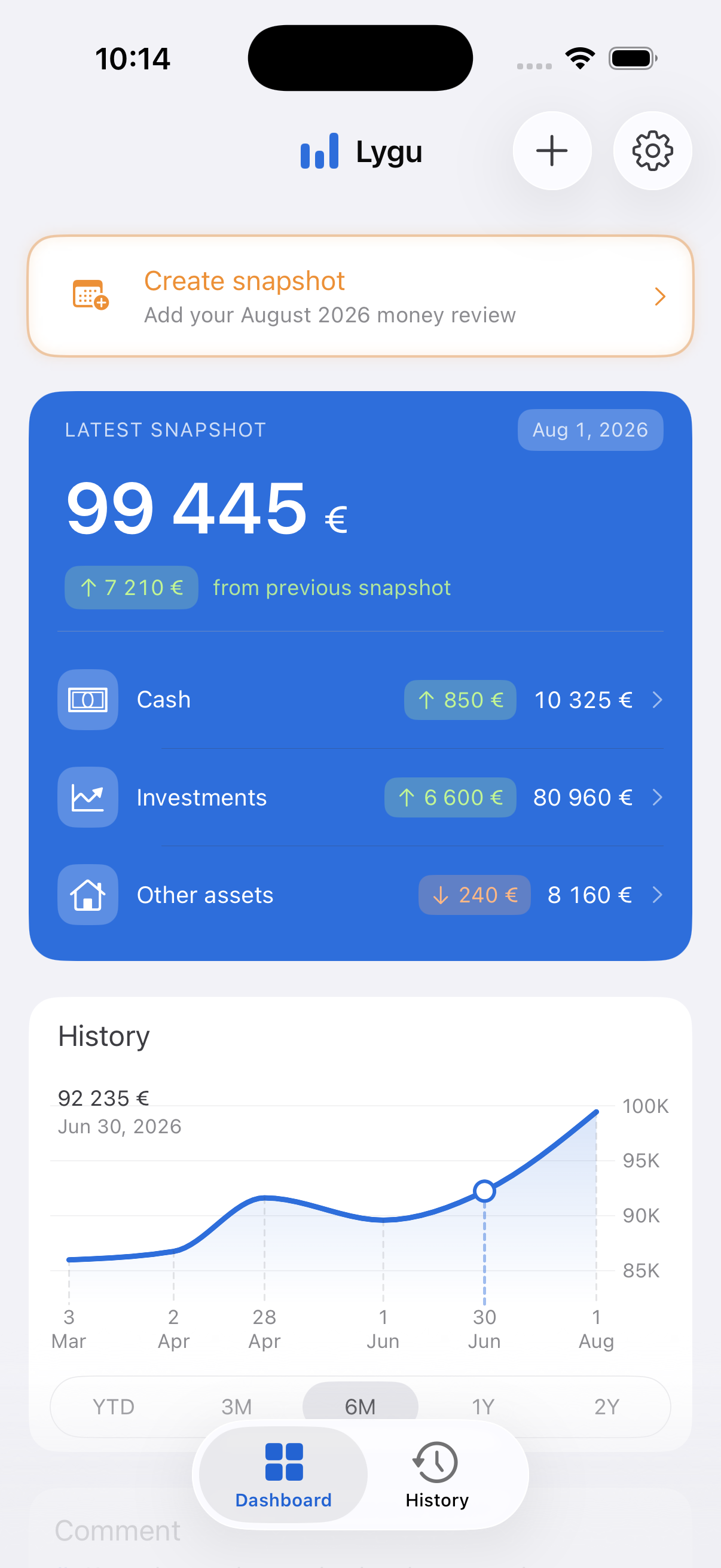
Lygu asks for one focused snapshot in about 15 minutes each month. You review cash, investments, debts, other assets, and income. Lygu compares snapshots to make the change visible, while optional notes give the numbers context.
You do not need to connect a bank or create a Lygu account. The lack of automatic transaction imports is deliberate: Lygu is built for periodic attention rather than continuous monitoring.
If you stopped tracking expenses
Illustrative scenario: you used to categorise every purchase, then stopped after a busy week. Rather than catching up on months of transactions, start with today’s cash, investment, debt, and asset balances. Save one snapshot. Next month, update the same balances, add income and investment activity, and compare the change.
You lose the ability to explain every purchase by category. You gain a smaller routine aimed at a different question: how did my overall position change? Follow the five-step monthly routine.
Daily tracking, a spreadsheet, or Lygu?
| Question | Daily tracking | Spreadsheet | Lygu |
|---|---|---|---|
| What do you record? | Individual transactions and categories. | Whatever your template covers: transactions or balances. | Periodic balances, income, investment activity, and reflections. |
| How much upkeep? | Regular entry or review of imported transactions. | Manual updates and maintaining your formulas. | Aim for about 15 minutes monthly; values are entered manually. |
| What can you learn? | Detailed spending by category. | Custom analysis you build into the sheet. | Net worth and category changes; estimated spending when inputs are complete. |
| Bank connection? | Depends on the tool. | Optional; depends on your setup. | None. |
| Main limitation | More detail to maintain. | You design and check the structure. | No transaction ledger or daily category limits. Full history and advanced analysis require Pro. |
Common questions
Do I need to catch up on missed transactions?
No. Begin with current balances. You do not need to reconstruct every purchase to create a baseline.
Is daily budgeting a bad idea?
No. It may suit you better when you need exact category totals or daily limits. Lygu is for a broader periodic review.
Can Lygu enforce a weekly spending budget?
No. It does not monitor transactions or enforce category limits. Use a tool designed for that level of detail if you need it.
What if I miss a month?
Return with an accurate snapshot. A comparison covers the interval since the previous snapshot; spending estimates across skipped months require the relevant income and use a monthly average.
Find the routine that fits.
Compare Lygu’s monthly approach with a traditional daily budgeting routine.
Compare the approaches